Signal transducer and activator of transcription 6 (STAT6) is a human gene. The protein encoded by this gene is a member of the STAT family of transcription factors.[5][6]
| STAT6 |
|---|
|
| Available structures |
|---|
| PDB | Ortholog search: PDBe RCSB |
|---|
| List of PDB id codes |
|---|
1OJ5, 4Y5W, 4Y5U |
|
|
| Identifiers |
|---|
| Aliases | STAT6, D12S1644, IL-4-STAT, STAT6B, STAT6C, signal transducer and activator of transcription 6 |
|---|
| External IDs | OMIM: 601512 MGI: 103034 HomoloGene: 2373 GeneCards: STAT6 |
|---|
| Gene location (Human) |
|---|
 | | Chr. | Chromosome 12 (human)[1] |
|---|
| | Band | 12q13.3 | Start | 57,095,408 bp[1] |
|---|
| End | 57,132,139 bp[1] |
|---|
|
| Gene location (Mouse) |
|---|
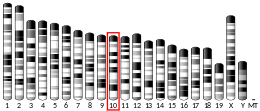 | | Chr. | Chromosome 10 (mouse)[2] |
|---|
| | Band | 10 D3|10 74.59 cM | Start | 127,642,986 bp[2] |
|---|
| End | 127,660,957 bp[2] |
|---|
|
| RNA expression pattern |
|---|
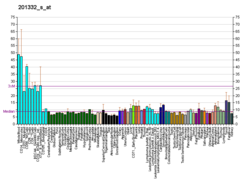
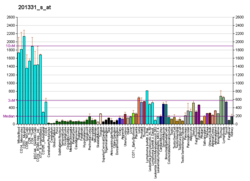 | | More reference expression data |
|
| Gene ontology |
|---|
| Molecular function | • identical protein binding
• sequence-specific DNA binding
• protein phosphatase binding
• DNA binding
• GO:0001948 protein binding
• GO:0001131, GO:0001151, GO:0001130, GO:0001204 DNA-binding transcription factor activity
• RNA polymerase II regulatory region sequence-specific DNA binding
• GO:0001077, GO:0001212, GO:0001213, GO:0001211, GO:0001205 DNA-binding transcription activator activity, RNA polymerase II-specific
• GO:0000980 RNA polymerase II cis-regulatory region sequence-specific DNA binding
• GO:0001200, GO:0001133, GO:0001201 DNA-binding transcription factor activity, RNA polymerase II-specific
|
|---|
| Cellular component | • cell nucleus
• nucleoplasm
• nuclear chromatin
• membrane raft
• cytoplasm
• cytosol
• nuclear membrane
|
|---|
| Biological process | • regulation of transcription from RNA polymerase II promoter
• T-helper 1 cell lineage commitment
• regulation of cell proliferation
• response to cytokine
• interleukin-4-mediated signaling pathway
• regulation of transcription, DNA-templated
• cellular response to hydrogen peroxide
• mammary gland epithelial cell proliferation
• cellular response to reactive nitrogen species
• positive regulation of type I interferon production
• positive regulation of isotype switching to IgE isotypes
• mammary gland morphogenesis
• negative regulation of type 2 immune response
• negative regulation of transcription from RNA polymerase II promoter
• signal transduction
• transcription, DNA-templated
• positive regulation of transcription from RNA polymerase II promoter
• transcription from RNA polymerase II promoter
• cytokine-mediated signaling pathway
• positive regulation of cold-induced thermogenesis
• defense response
• JAK-STAT cascade
• response to peptide hormone
• JAK-STAT cascade involved in growth hormone signaling pathway
|
|---|
| Sources:Amigo / QuickGO |
|
| Orthologs |
|---|
| Species | Human | Mouse |
|---|
| Entrez | | |
|---|
| Ensembl | | |
|---|
| UniProt | | |
|---|
| RefSeq (mRNA) | |
|---|
NM_001178078
NM_001178079
NM_001178080
NM_001178081
NM_003153 |
| |
|---|
| RefSeq (protein) | |
|---|
NP_001171549
NP_001171550
NP_001171551
NP_001171552
NP_003144 |
| |
|---|
| Location (UCSC) | Chr 12: 57.1 – 57.13 Mb | Chr 10: 127.64 – 127.66 Mb |
|---|
| PubMed search | [3] | [4] |
|---|
| Wikidata |
| View/Edit Human | View/Edit Mouse |
|
In response to cytokines and growth factors, STAT family members are phosphorylated by the receptor associated kinases, and then form homo- or heterodimers that translocate to the cell nucleus where they act as transcription activators. This protein plays a central role in exerting IL4 mediated biological responses. It is found to induce the expression of BCL2L1/BCL-X(L), which is responsible for the anti-apoptotic activity of IL4. Knockout studies in mice suggested the roles of this gene in differentiation of T helper 2 (Th2), expression of cell surface markers, and class switch of immunoglobulins.[7]
InteractionsEditSTAT6 has been shown to interact with:
- CREB-binding protein,[8][9]
- EP300,[8]
- IRF4,[10]
- NFKB1,[11]
- Nuclear receptor coactivator 1,[9][12] and
- SND1.[13]
PathologyEdit- Gene fusion
- Recurrent somatic fusions of the two genes, NGFI-A–binding protein 2 (NAB2) and STAT6, located at chromosomal region 12q13, have been identified in solitary fibrous tumors.[14]
- Amplification
- STAT6 is amplified in a subset of dedifferentiated liposarcoma.[15]



