Signal transducer and activator of transcription 2 is a protein that in humans is encoded by the STAT2 gene.[5][6] It is a member of the STAT protein family.
| STAT2 |
|---|
|
| Available structures |
|---|
| PDB | Ortholog search: PDBe RCSB |
|---|
|
|
| Identifiers |
|---|
| Aliases | STAT2, ISGF-3, P113, STAT113, IMD44, signal transducer and activator of transcription 2, PTORCH3 |
|---|
| External IDs | OMIM: 600556 MGI: 103039 HomoloGene: 3952 GeneCards: STAT2 |
|---|
| Gene location (Human) |
|---|
 | | Chr. | Chromosome 12 (human)[1] |
|---|
| | Band | 12q13.3 | Start | 56,341,597 bp[1] |
|---|
| End | 56,360,167 bp[1] |
|---|
|
| Gene location (Mouse) |
|---|
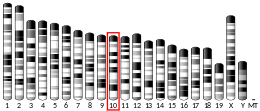 | | Chr. | Chromosome 10 (mouse)[2] |
|---|
| | Band | 10 D3|10 76.5 cM | Start | 128,270,559 bp[2] |
|---|
| End | 128,292,849 bp[2] |
|---|
|
| RNA expression pattern |
|---|
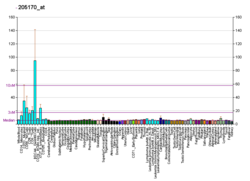
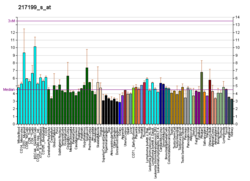 | | More reference expression data |
|
| Gene ontology |
|---|
| Molecular function | • DNA binding
• GO:0001131, GO:0001151, GO:0001130, GO:0001204 DNA-binding transcription factor activity
• GO:0001948 protein binding
• identical protein binding
• ubiquitin-like protein ligase binding
• GO:0001200, GO:0001133, GO:0001201 DNA-binding transcription factor activity, RNA polymerase II-specific
• signal transducer activity
• GO:0000980 RNA polymerase II cis-regulatory region sequence-specific DNA binding
• GO:0001077, GO:0001212, GO:0001213, GO:0001211, GO:0001205 DNA-binding transcription activator activity, RNA polymerase II-specific
|
|---|
| Cellular component | • cell membrane
• nucleoplasm
• cell nucleus
• cytoplasm
• cytosol
|
|---|
| Biological process | • JAK-STAT cascade
• regulation of transcription, DNA-templated
• regulation of transcription from RNA polymerase II promoter
• transcription, DNA-templated
• GO:0022415 viral process
• signal transduction
• regulation of protein phosphorylation
• defense response to virus
• regulation of mitochondrial fission
• type I interferon signaling pathway
• cytokine-mediated signaling pathway
• defense response
• regulation of cell proliferation
• response to peptide hormone
• positive regulation of transcription from RNA polymerase II promoter
|
|---|
| Sources:Amigo / QuickGO |
|
| Orthologs |
|---|
| Species | Human | Mouse |
|---|
| Entrez | | |
|---|
| Ensembl | | |
|---|
| UniProt | | |
|---|
| RefSeq (mRNA) | | |
|---|
| RefSeq (protein) | | |
|---|
| Location (UCSC) | Chr 12: 56.34 – 56.36 Mb | Chr 10: 128.27 – 128.29 Mb |
|---|
| PubMed search | [3] | [4] |
|---|
| Wikidata |
| View/Edit Human | View/Edit Mouse |
|
FunctionEditThe protein encoded by this gene is a member of the STAT protein family. In response to cytokines and growth factors, STAT family members are phosphorylated by the receptor associated kinases, and then form homo- or heterodimers that translocate to the cell nucleus where they act as transcription activators. In response to interferon (IFN), this protein forms a complex with STAT1 and IFN regulatory factor family protein p48 (IRF9), in which this protein acts as a transactivator, but lacks the ability to bind DNA directly. Transcription adaptor P300/CBP (EP300/CREBBP) has been shown to interact specifically with this protein, which is thought to be involved in the process of blocking IFN-alpha response by adenovirus.[6]



