Globo H (globohexaosylceramide) is a globo-series glycosphingolipid antigen that is present on the outer membrane of some cancer cells.[1][2] Globo H is not expressed in normal tissue cells, but is expressed in a number of types of cancers, including cancers of the breast, prostate, and pancreas.[1][3] Globo H’s exclusivity for cancer cells makes it a target of interest for cancer therapies.[1][2]

Structure
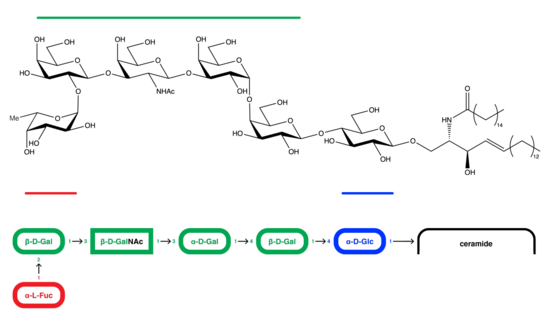
Defined by the monoclonal antibody MBr1, Globo H has been isolated from breast cancer cell line MCF-7, and its structure has been determined through several analyses, including NMR spectroscopy and methylation analysis.[5] Globo H consists of a hexasaccharide of the structure Fucα(1-2)Galβ(1-3)GalNAcβ(1-3)Galα(1-4)Galβ(1-4)Glcβ(1) with a ceramide attached to its terminal glucose ring at the 1 position in a beta linkage.[6]
Synthesis
Biosynthesis

Globo H’s biosynthetic pathway is involved in the synthesis pathways of other globo-series glycosphingolipid antigens that are also specific to cancer cells, including stage-specific embryonic antigen-3 (SSEA3) and stage-specific embryonic antigen-4 (SSEA4).[1] The biosynthetic pathway of these antigens includes the enzyme β 1,3-galactosyltransferase V (β3GalT5).[1] β3GalT5 catalyzes the galactosylation of globoside-4 (Gb4) to SSEA3.[1] SSEA3 can then be converted to SSEA4 by sialyltransferase adding a sialic acid group to its end, or it can be converted to Globo H by fucosyltransferase adding a fucose ring to its end.[1] Playing a part in the formation of three different cancer-specific antigens, β3GalT5 is of particular interest in its relevance to cancer treatment, and it has been shown to be critical for cancer cell survival.[8]
Chemical Synthesis
In order to study its potential as a cancer therapy target, Globo H has been synthesized in the laboratory.[9] One synthesis is achieved by first building two trisaccharides from their component sugars, and then linking them.[9] The trisaccharides, with most of their functional groups protected to prevent side reactions, are linked by creating the GalNAcβ(1-3)Gal bond.[9] A thioethyl group is added to the 1 position on one of the protected galactose rings, and in the presence of methyl triflate, this reacts with the hydroxyl group on the 3 position of the other galactose to link the trisaccharides and form the hexasaccharide.[9] The ceramide is added to the 1 position of the terminal glucose ring after hexasaccharide formation.[9]
Globo H as a Therapeutic Target
As a Tumor Associated Carbohydrate Antigen (TACA), Globo-H is a promising clinical target for immunotherapy. While absent in normal tissues, the glycosphingolipid is overexpressed in a variety of epithelial cancer cell types including human pancreatic, gastric, lung, colorectal, esophageal, and breast tumors.[10][11]
Globo H Anticancer Vaccines
Globo-H’s TACA character allows for its utilization as an anticancer vaccine, inducing antibody response against the epitope. The resulting humoral immunity could enable the selective eradication of Globo H-presenting tumors.[12] The Taiwanese biopharma company OBI Pharma, Inc., was first to develop Adagloxad Simolenin (OBI-822), a Globo H hexasaccharide conjugated with the immunostimulatory carrier protein KLH.[12] The Phase III GLORIA study is underway evaluating the carbohydrate-based immunogen’s effects in high risk triple-negative breast cancer (TNBC) patients with an estimated completion date in 2027.[13]
Alternative vaccine conjugates have been developed which avoid issues associated with the protein carrier KLH by substituting it with a lipid or carbohydrate-based carrier. Examples include the use of lipid A derivatives[14] or entirely carbohydrate vaccine conjugates such as Globo H-PS A1[15]
Anti-Globo H Antibodies
Globo H-targeting antibodies are another strategy currently being evaluated in the cancer therapeutic space. OBI Pharma’s OBI-888 is a humanized IgG1 antibody that selectively binds to the Globo H antigen among other Globo series glycosphingolipids such as SSEA-3 and SSEA-4.[16] Additionally, in vivo studies of OBI-888 in various Globo H-positive (GH+) xenografts models showed promising tumor growth inhibition results.[17] OBI-888’s human Phase I/II study for the treatment of metastatic and locally advanced solid tumors is estimated to finish in December 2022.[18]
Based on OBI-888, the first-in-class antibody-drug conjugate (ADC) 0BI-999 was additionally developed, linking OBI-888 to monomethyl auristatin E, a synthetic antineoplastic agent.[19] The ADC is currently undergoing phase II trial in patients with advanced solid tumors, with an estimated completion date in Dec 2023.[20] In Dec 2019 & Jan 2020, OBI-999 was granted two Orphan Drug Designations by the FDA for the treatment of pancreatic and gastric cancer.[21]
| This article uses material from the Wikipedia article Metasyntactic variable, which is released under the Creative Commons Attribution-ShareAlike 3.0 Unported License. |