HLA class II histocompatibility antigen gamma chain also known as HLA-DR antigens-associated invariant chain or CD74 (Cluster of Differentiation 74), is a protein that in humans is encoded by the CD74 gene.[5][6] The invariant chain (Abbreviated Ii) is a polypeptide which plays a critical role in antigen presentation. It is involved in the formation and transport of MHC class II peptide complexes for the generation of CD4+ T cell responses.[7][8] The cell surface form of the invariant chain is known as CD74. CD74 is a cell surface receptor for the cytokine macrophage migration inhibitory factor (MIF).[9]
| CD74 |
|---|
 |
| Available structures |
|---|
| PDB | Ortholog search: PDBe RCSB |
|---|
| List of PDB id codes |
|---|
1A6A, 1ICF, 1IIE, 1L3H, 1MUJ, 3PDO, 3PGC, 3PGD, 3QXA, 3QXD, 4AEN, 4X5W |
|
|
| Identifiers |
|---|
| Aliases | CD74, DHLAG, HLADG, II, Ia-GAMMA, CD74 molecule, p33 |
|---|
| External IDs | OMIM: 142790 MGI: 96534 HomoloGene: 3209 GeneCards: CD74 |
|---|
| Gene location (Human) |
|---|
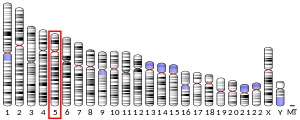 | | Chr. | Chromosome 5 (human)[1] |
|---|
| | Band | 5q33.1 | Start | 150,400,041 bp[1] |
|---|
| End | 150,412,929 bp[1] |
|---|
|
| Gene location (Mouse) |
|---|
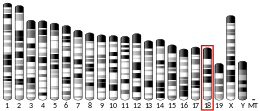 | | Chr. | Chromosome 18 (mouse)[2] |
|---|
| | Band | 18 E1|18 34.41 cM | Start | 60,803,848 bp[2] |
|---|
| End | 60,812,652 bp[2] |
|---|
|
| RNA expression pattern |
|---|
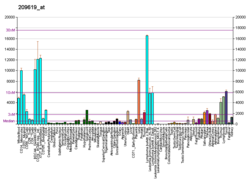 | | More reference expression data |
|
| Gene ontology |
|---|
| Molecular function | • nitric-oxide synthase binding
• identical protein binding
• MHC class II protein binding, via antigen binding groove
• cytokine receptor activity
• macrophage migration inhibitory factor binding
• protein binding involved in protein folding
• MHC class II protein complex binding
• amyloid-beta binding
• GO:0001948 protein binding
• MHC class II protein binding
• cytokine binding
• CD4 receptor binding
|
|---|
| Cellular component | • lysosomal lumen
• extracellular exosome
• MHC class II protein complex
• lysosomal membrane
• late endosome
• endocytic vesicle membrane
• transport vesicle membrane
• integral component of membrane
• ER to Golgi transport vesicle membrane
• multivesicular body
• Golgi apparatus
• Golgi membrane
• trans-Golgi network membrane
• macrophage migration inhibitory factor receptor complex
• membrane
• cell surface
• intracellular
• integral component of lumenal side of endoplasmic reticulum membrane
• endoplasmic reticulum
• endoplasmic reticulum membrane
• cell membrane
• lysosome
• vacuole
• endosome
• clathrin-coated endocytic vesicle membrane
• NOS2-CD74 complex
• external side of plasma membrane
|
|---|
| Biological process | • immune response
• positive regulation of T cell differentiation
• negative regulation of apoptotic process
• signal transduction
• positive thymic T cell selection
• chaperone mediated protein folding requiring cofactor
• T cell selection
• activation of MAPK activity
• positive regulation of type 2 immune response
• positive regulation of dendritic cell antigen processing and presentation
• antigen processing and presentation of exogenous peptide antigen via MHC class II
• adaptive immune response
• antigen processing and presentation
• positive regulation of peptidyl-tyrosine phosphorylation
• negative regulation of mature B cell apoptotic process
• regulation of macrophage activation
• negative regulation of DNA damage response, signal transduction by p53 class mediator
• immunoglobulin mediated immune response
• leukocyte migration
• positive regulation of neutrophil chemotaxis
• positive regulation of chemokine (C-X-C motif) ligand 2 production
• macrophage migration inhibitory factor signaling pathway
• prostaglandin biosynthetic process
• cellular proliferation
• antigen processing and presentation of endogenous antigen
• immune system process
• defense response
• negative regulation of peptide secretion
• negative regulation of T cell differentiation
• positive regulation of macrophage cytokine production
• positive regulation of B cell proliferation
• negative thymic T cell selection
• positive regulation of fibroblast proliferation
• intracellular protein transport
• positive regulation of ERK1 and ERK2 cascade
• negative regulation of intrinsic apoptotic signaling pathway in response to DNA damage by p53 class mediator
• positive regulation of cytokine-mediated signaling pathway
• positive regulation of protein phosphorylation
• positive regulation of kinase activity
• positive regulation of I-kappaB kinase/NF-kappaB signaling
• positive regulation of MAPK cascade
• positive regulation of monocyte differentiation
• positive regulation of transcription, DNA-templated
• positive regulation of viral entry into host cell
• protein heterotetramerization
• protein trimerization
• macromolecular complex assembly
|
|---|
| Sources:Amigo / QuickGO |
|
| Orthologs |
|---|
| Species | Human | Mouse |
|---|
| Entrez | | |
|---|
| Ensembl | | |
|---|
| UniProt | | |
|---|
| RefSeq (mRNA) | |
|---|
NM_004355
NM_001025158
NM_001025159
NM_001364083
NM_001364084 |
| |
|---|
| RefSeq (protein) | |
|---|
NP_001020329
NP_001020330
NP_004346
NP_001351012
NP_001351013 |
| |
|---|
| Location (UCSC) | Chr 5: 150.4 – 150.41 Mb | Chr 18: 60.8 – 60.81 Mb |
|---|
| PubMed search | [3] | [4] |
|---|
| Wikidata |
| View/Edit Human | View/Edit Mouse |
|
FunctionEditThe nascent MHC class II protein in the rough endoplasmic reticulum (RER) binds a segment of the invariant chain (Ii; a trimer) in order to shape the peptide-binding groove and prevent the formation of a closed conformation.
The invariant chain also facilitates the export of MHC class II from the RER in a vesicle. The signal for endosomal targeting resides in the cytoplasmic tail of the invariant chain. This fuses with a late endosome containing the endocytosed antigen proteins (from the exogenous pathway). Binding to Ii ensures that no antigen peptides from the endogenous pathway meant for MHC class I molecules accidentally bind to the groove of MHC class II molecules.[10] The Ii is then cleaved by cathepsin S (cathepsin L in cortical thymic epithelial cells), leaving only a small fragment called CLIP remaining bound to the groove of MHC class II molecules. The rest of the Ii is degraded.[10] CLIP blocks peptide-binding until HLA-DM interacts with MHC II, releasing CLIP and allowing other peptides to bind. In some cases, CLIP dissociates without any further molecular interactions, but in other cases the binding to the MHC is more stable.[11]
The stable MHC class II + antigen complex is then presented on the cell surface. Without CLIP, MHC class II aggregates disassemble and/or denature in the endosomes, and proper antigen presentation is impaired.[12]
Clinical significanceEditVaccine adjuvantEdit
The Ii molecule—fused with a viral vector to a conserved region of the Hepatitis C virus (HCV) genome—has been tested as an adjuvant for a HCV vaccine in a cohort of 17 healthy human volunteers. This experimental vaccine was well-tolerated, and those who received the adjuvanted vaccine had stronger anti-HCV immune responses (enhanced magnitude, breadth and proliferative capacity of anti-HCV-specific T-cells) compared with volunteers who received the vaccine that lacked the Ii adjuvant.[13]
The Ii molecule might also prove to be useful as an adjuvant for a future vaccine for the SARS-CoV-2 virus, if this enhancing effect can be demonstrated to apply to the appropriate antigen(s).[14]
CancerEdit
Found on a number of cancer cell types. Possible cancer therapy target. See milatuzumab.
Axial spondyloarthritisEdit
Autoantibodies against CD74 have been identified as promising biomarkers in the early diagnosis of the autoimmune disease called axial spondyloarthritis (non-radiographic axial spondyloarthritis and radiographic axial spondyloarthritis / Ankylosing spondylitis). [15]
InteractionsEditCD74 receptor interacts with the cytokine Macrophage migration inhibitory factor (MIF) to mediate some of its functions.[16][17][18][19][20][21]
Recovery functionsEdit
Role of CD74 receptor in tissue injury and wound repair
CD74 receptor is expressed on the surface of different cell types. Interaction between MIF cytokine and its cell membrane receptor CD74 activates pro-survival and proliferative pathways that protect against injury and promote healing in different parts of the body.[22]



